Off the Bestseller List and Into Your Heart: Britain's Quiet Revolt Against Literary Hype
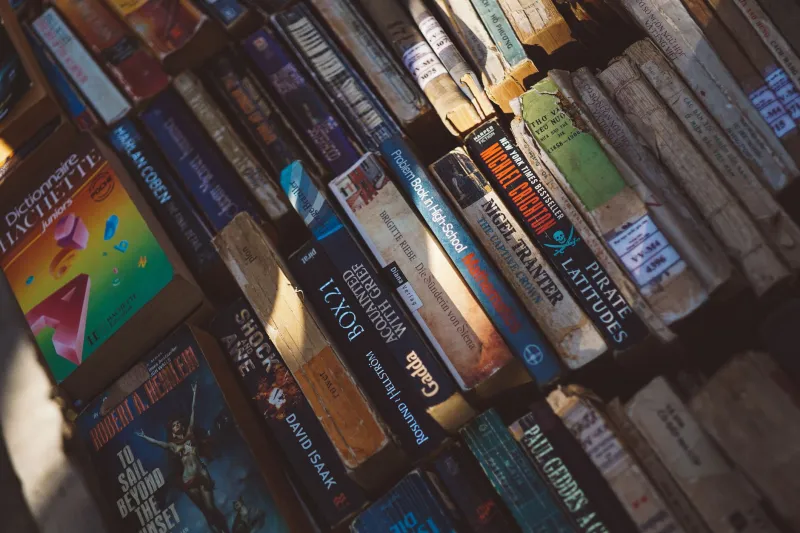
Let's start with a confession: the last book that genuinely changed Helen's life had a cover so ugly she almost put it back on the shelf. It was a 1974 paperback she found in a charity shop in Shrewsbury — spine faded, pages the colour of old mustard, author entirely unknown to her. She bought it for 50p mostly because it was raining and she had nowhere to be.
Six weeks later, she'd pressed copies into the hands of everyone she knew.
"I'd never heard of it," says Helen, a 47-year-old graphic designer from Telford. "There was no buzz. No one was talking about it on social media. It wasn't on any list anywhere. And it was extraordinary."
This is the quiet paradox at the heart of what some readers are calling the backlist rebellion — the growing conviction that the books nobody's talking about might be exactly the ones worth reading.
The Tyranny of the Trending
Publishing has always had its fashions, its moments, its breakout titles. But something about the current cultural landscape — with its social media algorithms, its BookTok verticals, its chart-obsessed retail culture — has amplified the noise around certain books to a degree that can feel genuinely exhausting.
The result, many readers say, is a kind of literary monoculture: the same dozen titles appearing in every window display, on every podcast, in every "what I'm reading" Instagram post. And while those books are often genuinely good, the sheer relentlessness of their visibility can make reading feel less like discovery and more like consumption.
"I started to notice that I was choosing books based on what I thought I should be reading," admits Callum, a 38-year-old from Glasgow. "And then I'd finish them and feel... nothing. No connection. Like I'd eaten something that looked appealing but had no flavour."
His solution was radical in its simplicity: he stopped looking at bestseller lists entirely. For an entire year, he committed to buying only books published before 1990, by authors he'd never heard of, from charity shops and car boot sales. "I called it my ignorance project," he laughs. "Deliberately choosing books I had no prior opinion about."
What he found surprised him. "I read more joyfully that year than I had in a decade."
The Charity Shop as Cultural Compass
For Britain's backlist rebels, the charity shop has become something close to sacred ground. Unlike a bookshop curated for commercial appeal, or an algorithm tuned to your previous behaviour, the charity shop is beautifully indifferent. It contains what people have loved enough to own and eventually let go. It has no agenda.
Rachel, a 55-year-old retired nurse from Norwich, has been charity-shop hunting for books for nearly twenty years. She describes her method as "following instinct over information."
"I look at the cover, I read the first paragraph, I notice how the book feels in my hands," she says. "I'm not Googling the author. I'm not checking reviews. I'm just deciding whether something calls to me."
This stripping away of external validation — the star ratings, the recommendation algorithms, the influencer endorsements — is, readers say, surprisingly liberating. It returns the act of choosing a book to something more intuitive and personal.
"When a book has no hype attached to it," says Callum, "you experience it purely. There's no expectation to manage. If it moves you, it's because it moved you — not because someone told you it would."
What's Actually Out There
The backlist, it turns out, is enormous. And it contains multitudes.
There are the mid-century British novelists who were critically adored in their time and have since drifted out of print — writers like Barbara Comyns, Patrick Hamilton, or Sylvia Townsend Warner, whose work readers are now rediscovering with something approaching disbelief at how good it is. There are the translated novels that never quite made it into the mainstream consciousness but quietly shaped entire literary traditions. There are debut novels from the 1980s and 90s that sold modestly, got decent reviews, and then simply... vanished.
Finding these books requires a different kind of effort — less scrolling, more wandering. But readers describe the search itself as part of the pleasure.
"I've started going into secondhand bookshops with no list and no plan," says Mei, a 31-year-old teacher from Bristol. "I just browse until something stops me. Last month I found a novel from 1963 that I'd never heard of, by a Welsh author who apparently wrote three books and then disappeared completely. It was one of the most beautiful things I've ever read. And I almost certainly would never have encountered it if I'd been following any kind of recommendation system."
The Authenticity Hunger
There's a broader cultural conversation embedded in all of this — one about authenticity, about the weariness many people feel with curated, optimised, performance-ready culture. The backlist rebellion is, in this sense, of a piece with other quiet revolts: against fast fashion, against content creation, against the relentless pressure to consume what's current.
"I think a lot of us are just tired," says Helen. "Tired of being told what's good, what's relevant, what we should care about. There's something deeply restful about picking up a book that has no expectations attached to it whatsoever."
For some readers, the choice of a forgotten book is almost a political act — a refusal to participate in the commercial machinery that decides which stories get amplified and which ones quietly disappear.
"Every time I buy a book that isn't on any list," says Rachel, "I feel like I'm honouring something. A writer who worked hard and maybe never got the attention they deserved. A story that still has things to say, even if nobody's saying it should."
The Unexpected Joy of Getting It Wrong
Of course, not every forgotten book is a hidden masterpiece. Some of them are forgotten for excellent reasons. Readers are cheerfully honest about this.
"I've read some absolute rubbish," laughs Callum. "Books that were clearly terrible in 1987 and remain terrible today. But even that's sort of freeing? There's no pressure. I didn't choose it because someone told me it would change my life. I chose it because it was 30p and had a picture of a lighthouse on the cover."
This willingness to read without expectation — to be delighted or disappointed without either outcome feeling like a personal failure — might be the most radical thing about the backlist rebellion. It reframes reading as exploration rather than achievement.
And sometimes, in the middle of that exploration, you find something extraordinary. A 1974 paperback with an ugly cover. An author no one remembers. A story that reaches across fifty years and lands, somehow, exactly where you needed it to.
That's not an algorithm's doing. That's just the beautiful, unrepeatable luck of an open mind and a charity shop shelf.