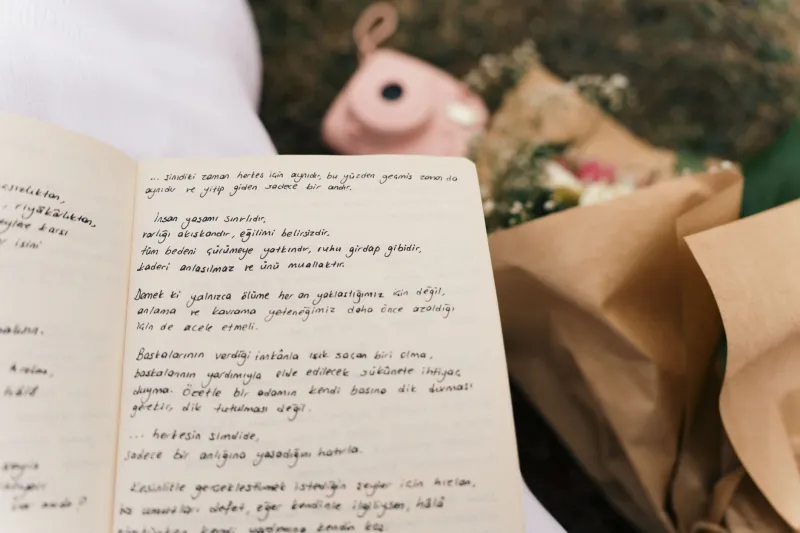
Dear Future Me: The British Readers Writing Love Letters in Their Book Margins

Somewhere in a Bristol flat, a 34-year-old primary school teacher called Naomi is rereading a novel she first picked up at nineteen. She's not just reading it. She's having a conversation with herself.
In the margins, in a younger hand — looping, slightly frantic — are the words she wrote over a decade ago. This is exactly how it feels. I thought I was the only one. Now, in steadier ink, she writes beneath her younger self's note: You weren't. You never were.
"It made me cry," she says, simply. "But the good kind. The kind that means something shifted."
This is margin annotation — and it's having a quiet, rather beautiful moment in Britain.
More Than Marginalia
For centuries, readers have scribbled in the borders of their books. Scholars did it. Students did it. Darwin did it, famously and prolifically. But what's emerging now is something subtly different from academic notation or literary analysis. People aren't just flagging interesting passages — they're processing grief, tracking growth, leaving messages for the selves they haven't yet become.
Sarah, a 41-year-old from Edinburgh, describes her annotated books as "emotional diaries I didn't know I was keeping." She started underlining passages that resonated during a difficult divorce seven years ago. "I wasn't journalling — I couldn't face a blank page," she explains. "But I could underline a sentence and write two words next to it. Sometimes just yes or this or remember this."
When she returned to those books recently, she found something she hadn't expected: a record of her own healing. "I could see myself changing, paragraph by paragraph, book by book. There's something almost archaeological about it."
What Therapists Are Noticing
The practice isn't going unnoticed in therapeutic circles either. Dr. Priya Mehta, a cognitive behavioural therapist based in Manchester, has begun recommending what she loosely calls "annotated reading" to some of her clients — particularly those who struggle with traditional journalling or find talking therapies emotionally overwhelming at first.
"There's something about the structure of a book that makes it feel safer," she explains. "You're not staring into the void of a blank page. The text gives you scaffolding. When a client underlines a passage that resonates and writes a single note beside it, they're externalising an internal experience — which is the beginning of processing it."
She's careful to note that annotation isn't therapy in itself. But as a complement to other support, she's seen it help clients articulate feelings they hadn't previously been able to name. "One client told me she'd written this is the loneliness I couldn't describe next to a paragraph in a novel. That sentence — her sentence — became a doorway into a conversation we'd been trying to have for weeks."
The Time Capsule Effect
What makes margin annotation different from journalling is the element of time. A journal entry exists in isolation. Margin notes exist in relationship — to the text, and to every future version of yourself who will one day open that same page.
James, a 52-year-old librarian from Leeds, has been annotating books since his twenties. He describes the experience of rereading an old annotated novel as "meeting a ghost — except the ghost is you."
"I found a copy of Middlemarch last year that I'd read at twenty-six," he says. "I'd written I don't understand why she stays next to one of Dorothea's choices. When I read it now, I understand completely. That gap — between who I was and who I am — is right there in the margin. It's humbling and a bit wonderful."
This temporal quality is part of what makes the practice feel so emotionally resonant. You are, in a very literal sense, leaving a message for your future self — and trusting that they'll receive it with kindness.
The Rules (or Lack of Them)
One of the most liberating things about margin annotation, readers say, is that there are no rules. No correct format, no required frequency, no expectation of coherence or eloquence. Some people use pencil so they can erase. Others use pen because permanence is the point. Some draw small symbols — stars, question marks, tiny suns. Others write full sentences, or fragments, or just a name.
Amara, a 29-year-old writer from Birmingham, has developed her own personal shorthand over years of reading. A small heart means this healed something. A bracket with an asterisk means come back to this when things are hard. A simple underline with no note means I felt this too deeply to explain.
"It's my own language," she says. "No one else would know what it means. And that's exactly why it works."
Giving Yourself Permission
For many readers, there's still an initial resistance — a sense that writing in books is somehow wrong, a desecration of something sacred. But those who've pushed past that hesitation often describe a kind of liberation on the other side.
"I was raised to think of books as precious objects you didn't touch," admits Naomi, the Bristol teacher. "The first time I wrote in one, my hand was actually shaking. But then I wrote this is the most seen I've ever felt next to a passage, and something opened up. The book became mine in a way it hadn't been before."
Dr. Mehta agrees that this sense of ownership is psychologically significant. "When you annotate, you're not a passive recipient of someone else's story. You're actively bringing your own experience into dialogue with it. That's an act of self-respect, really — saying that your response matters enough to record."
A Conversation Across Time
Perhaps the most moving aspect of this practice is its fundamental optimism. To write a note in a margin is to believe — even if only somewhere quiet and unconscious — that there will be a future self to read it. That you will, in time, return. That you will grow, change, soften, or strengthen enough to look back at who you were with something like tenderness.
Sarah, rereading those books she annotated during her divorce, says she sometimes writes replies to her younger self. Not to correct her, but to comfort her. You made it. You're okay. Look how far.
"It sounds a bit daft when I say it out loud," she laughs. "But it's one of the kindest things I've ever done for myself."
That, perhaps, is the real magic of the annotated book. Not the literary analysis, not the clever observation, not the perfectly turned phrase — but the simple, radical act of leaving a light on for the person you're still becoming.