Ode to the Drizzle: Meet the Poets Turning Britain's Grey Skies into Pure Gold

Photo: Shixart1985, CC BY 2.0, via Wikimedia Commons
Ode to the Drizzle: Meet the Poets Turning Britain's Grey Skies into Pure Gold
It is raining in Huddersfield. It has been raining since Tuesday. The sky is the colour of old pewter and the pavements are doing that thing they do in October — reflecting the streetlights in long, trembling ribbons of amber and white. Most people are hurrying past with their collars up, muttering. But on the top floor of a converted mill, a woman called Clare is sitting by a rain-streaked window with a notebook, and she is smiling.
"This is exactly what I need," she says, gesturing at the streaming glass. "Days like this are where half my best work comes from."
Clare is one of a growing and quietly thriving community of poets across Britain who have made the nation's most moaned-about characteristic — its relentless, democratic, thoroughly unimpressed-by-your-plans weather — into the raw material of something genuinely beautiful. Not in a gloomy, pathetic fallacy sort of way. Not in the manner of someone turning misery into verse. But in a spirit of real, unironic affection: a creative love letter to fog, to drizzle, to the particular magic of a grey afternoon that asks nothing of you except your attention.
The Muse Nobody Asked For
Britain's weather has always been more than meteorology. It is national identity, conversational currency, collective experience. We bond over it, grumble about it, measure our seasons by its moods rather than the calendar. It is, in a very real sense, the backdrop against which British life is lived — and yet, in literary terms, it has rarely been celebrated with the same warmth we give our landscapes, our coastlines or our countryside.
That is changing. Across the country, from the misty valleys of South Wales to the rain-lashed fishing villages of the Northumberland coast, poets — many of them amateurs writing for love rather than publication, many of them newcomers to the form — are discovering that there is extraordinary creative richness in the mundane damp of everyday British weather.
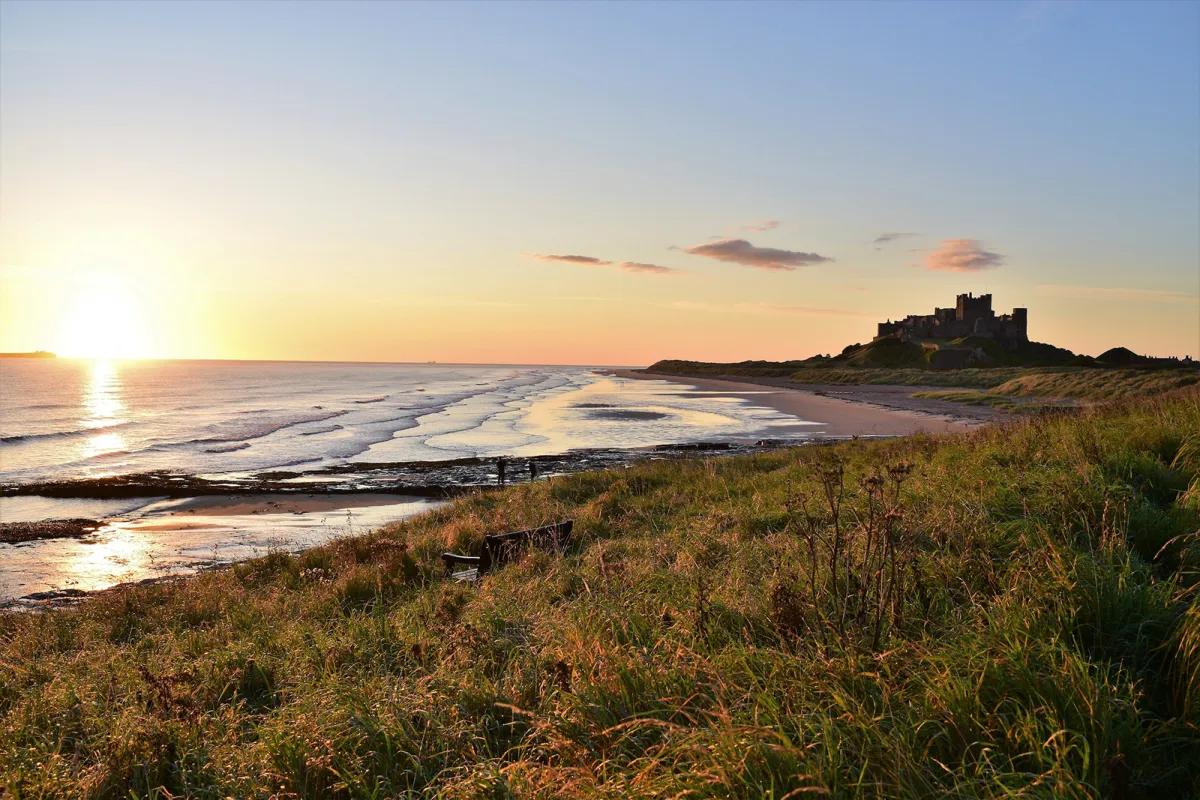 Photo: Northumberland coast, via www.johansens.com
"I think we've been conditioned to apologise for it," says Jonah, a secondary school teaching assistant from Stockport who started writing weather poems during lockdown and now runs a small monthly zine called Grey Is a Colour Too. "But when you actually look at a rainy day — really look — it's astonishing. The way fog changes a familiar street into something mysterious. The sound of rain on different surfaces. The smell of wet earth. It's all there waiting, and it's free."
Finding the Wonder in the Wet
The poems being written in this tradition tend to share a particular quality: a refusal to treat the ordinary as merely ordinary. They are observational in the way that the best nature writing is observational — patient, precise, alert to the small and the overlooked. A poem about a puddle becomes a meditation on reflection and distortion. A piece about fog becomes an exploration of how mystery can be comforting rather than frightening. A sequence about November rain becomes, unexpectedly, a love letter to the season of drawing in.
Lianne, a retired district nurse from Aberystwyth, began writing about Welsh weather three years ago after her daughter bought her a poetry workshop as a birthday present. She had never written a poem in her adult life. Now she has a collection of over forty pieces, many of which she shares through a community noticeboard project in her town and a modest but loyal Instagram following.
"My favourite poem I've ever written is about a particular shade of grey," she says, laughing slightly at how that sounds. "It's about looking out at the sea on an overcast morning and realising that grey isn't one colour at all — it's hundreds of colours pretending to be modest. I think that's what I love about our weather. It rewards patience. You have to slow down to see it properly."
The Gratitude Connection
What strikes many of the poets in this community is the unexpected relationship between writing about dull weather and feeling, paradoxically, more grateful. There is something in the act of looking closely at what you might otherwise dismiss that seems to generate genuine appreciation — not just for the rain itself, but for the life being lived inside it.
"I wrote a poem about walking the dog in the drizzle one Sunday morning and I cried writing it," admits Patrick, a warehouse supervisor from Coventry who has been writing poetry for two years. "Not because it was sad. Because when I actually wrote it all down — the way my dog looked with wet ears, the smell of the privet hedges, the sound of someone's Radio 4 drifting out of an open window — I realised how much I love my ordinary life. The rain just... made me notice it."
This is, psychologists might suggest, gratitude practice in disguise. The act of transforming an experience into language requires you to inhabit it fully, to find its texture and its particularity. And in doing so, you almost inevitably discover that it contains more beauty than you initially credited.
Where the Work Lives
One of the most delightful aspects of this movement is where these poems end up. Few of the poets we spoke to are primarily chasing publication in prestigious literary journals, though some have found their way there. Instead, their work circulates through channels that feel genuinely community-rooted.
Local zines — photocopied, folded, sold for a pound at farmers' markets and independent cafés — are perhaps the most common vehicle. Community noticeboards, particularly in libraries and village halls, are another favourite. Several poets described tucking handwritten verses into second-hand books at charity shops, or leaving printed poems in café windows with an open invitation for others to add their own.
Social media, particularly Instagram and the poetry communities on TikTok (affectionately known as BookTok's quieter sibling, PoemTok), has given many of these writers their widest audiences. Short, image-rich weather poems — often posted alongside photographs of rain-blurred windows or fog-draped hills — travel surprisingly well in the visual landscape of social platforms.
"I had a poem about a November afternoon share about four thousand times," says Jonah, still sounding faintly bewildered. "People were tagging their friends saying 'this is us every weekend.' There's a hunger for this, I think. People want permission to find their grey, rainy country beautiful instead of embarrassing."
An Invitation to Look Again
If there is a single message that emerges from spending time with these poets, it is this: the material for wonder is already outside your window. You do not need a dramatic landscape or a blazing sunset. You need a notebook, a willingness to sit still for a moment and the quiet audacity to look at a puddle as though it might have something to tell you.
Britain's grey skies have been muse enough for centuries of writers — from Gerard Manley Hopkins finding "dappled things" in overcast light to Ted Hughes tracking weather across the Yorkshire moors with the focus of a naturalist. The poets writing today in this tradition are not doing anything new. They are simply rediscovering something that has always been true: that the ordinary, looked at with sufficient love, becomes extraordinary.
The rain is still falling in Huddersfield. Clare is still smiling.
Her notebook, when she tilts it toward the window, is already half full.