Fifteen Minutes of Pure: The Office Poets Quietly Changing How Britain Does Lunchtime
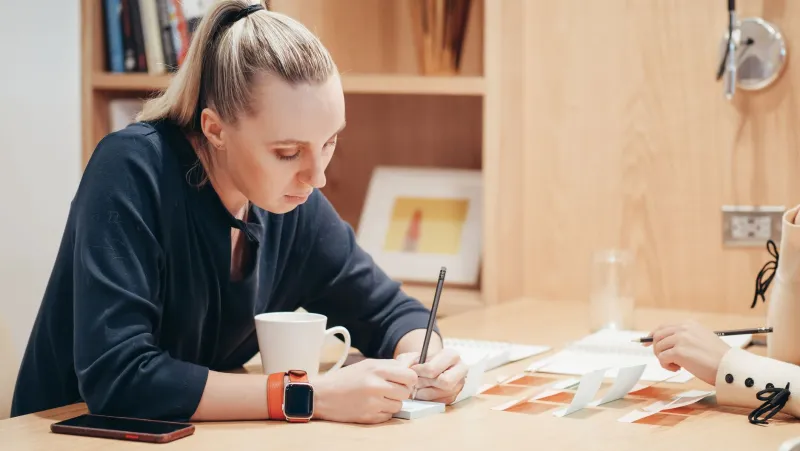
Somewhere between the microwave ping and the afternoon meeting reminder, something rather lovely is happening in Britain's workplaces. People are writing poetry. Not at home, not at a weekend retreat, not after years of creative writing courses — but right there, in the staffroom, in the corner of the canteen, perched on a low wall outside a factory entrance with a sandwich in one hand and a biro in the other.
It's unofficial. It's unhurried. And for a growing number of UK workers, it has become the most important fifteen minutes of their entire day.
How It Started: The Accidental Poets
Nobody really planned any of this. That's perhaps the most charming thing about Britain's emerging lunch-hour poetry movement — it didn't arrive with a manifesto or a wellness budget. It crept in quietly, the way the best things usually do.
Take Priya, a ward administrator at an NHS trust in Birmingham. Two years ago, she started jotting fragments of thought into a small notebook during her break rather than reaching for her phone. "I wasn't trying to write poetry," she laughs. "I was just trying to get out of my own head for a bit. But the sentences started getting shorter and more deliberate, and one day my colleague looked over my shoulder and said, 'That's a poem, that is.' I suppose it was."
Priya now runs an informal group of seven colleagues who meet twice a week under the hospital's main staircase — a spot they've christened, with characteristic NHS wit, "the ICU: Intentional Creativity Unit." Nobody is required to share what they write. Nobody is graded. The only rule is that phones stay in pockets.
Why Poetry, Specifically?
It's a fair question. Of all the creative outlets available to a time-pressed professional, why verse? Why not sketching, or journalling, or simply sitting quietly with a cup of tea?
The answer, it turns out, lies in poetry's particular relationship with constraint. A poem doesn't need to be long. It doesn't need a beginning, middle and end. It doesn't require the kind of sustained concentration that a lunch break rarely allows. A single image, a fragment of feeling, three lines that capture something true — that's enough. That's, in fact, the whole point.
Dr Rachel Hennessy, a psychologist based in Edinburgh who has researched creative expression in workplace settings, puts it simply: "Poetry asks you to compress rather than expand. For people who feel overwhelmed by the volume of everything — emails, decisions, noise — that compression is genuinely therapeutic. You're not adding to the pile. You're distilling it."
Research from the University of Exeter has suggested that even brief creative writing sessions during working hours can meaningfully reduce cortisol levels and improve afternoon focus. Anecdotally, the lunch-hour poets of Britain seem to have arrived at the same conclusion entirely on their own.
From Factory Floor to Verse Form
What makes this movement particularly heartening is just how broad it is. This isn't exclusively a middle-class, artisan-coffee sort of pursuit. Far from it.
In a logistics warehouse on the outskirts of Leeds, a group of eight workers — mostly men in their forties and fifties — gather near the loading bay entrance on dry days, or squeeze into the break room when it rains. The group was started by Marcus, a forklift driver who'd stumbled across a collection of Ted Hughes poems in a charity shop and found himself unexpectedly moved.
"The lads were suspicious at first," he admits. "Poetry was posh, or it was school, or it was something your gran liked. But I read them a few bits and then someone said, 'I reckon I could do that.' And he did. And it was brilliant. Really honest, like."
The group has since filled three shared notebooks. They don't perform their work or post it online. The poems exist purely for the people in the room, which Marcus believes is precisely why it works. "There's no pressure. It's just ours."
In a legal firm in central Manchester, the dynamic is slightly different. Here, a group of paralegals and junior solicitors use a shared online document — old habits die hard — to contribute lines during their respective breaks throughout the day, building collaborative poems that nobody quite owns. "It's become this strange, beautiful thing we all made together," says Fiona, a paralegal who coordinates the project. "By Friday afternoon, there's always something there that surprises us."
The Phone Problem — and the Antidote
It would be dishonest to write about lunch-hour poetry without acknowledging what it's replacing. The average British adult spends over two hours a day on their phone, and a significant chunk of that time falls in those supposedly restorative gaps between work tasks. Lunch breaks, which were once genuinely recuperative, have quietly become extensions of the digital working day.
The poets themselves are candid about this. "I used to eat my lunch scrolling through news that made me feel terrible," says Priya. "Now I write four lines about the colour of the sky outside the window, and I go back to my desk feeling like a person again."
There's something quietly radical about that. Not in a grand, political sense — but in the small, personal sense that matters most to wellbeing. Choosing to make something, rather than consume something, during the precious minutes that belong entirely to you.
Starting Your Own Midday Moment
If the idea appeals — and there's every reason it should — the barrier to entry is wonderfully low. You need a pen. You need paper. You need a willingness to write something imperfect and not mind.
Many of Britain's lunch-hour poets recommend starting with a simple prompt: describe one thing you can see, one thing you can hear, and one thing you're feeling. Let those three elements sit together on the page and see what happens. It might not look like a poem. It might not feel like one. But give it a week, and something will begin to shift.
As Marcus from the Leeds warehouse puts it, with the kind of straightforward poetry that probably belongs in a notebook of its own: "You spend all day doing things for other people. Fifteen minutes making something just for yourself — that's not indulgent. That's survival."
And somewhere across Britain, in canteens and corridors and car parks and quiet corners, thousands of people are discovering he's absolutely right.