The Night-Time Ritual That Happier Britons Swear By: What's Really on Their Bedside Tables

The Night-Time Ritual That Happier Britons Swear By: What's Really on Their Bedside Tables
There is a particular kind of contentment that settles over you when you close a book at night, switch off the lamp and feel genuinely ready for sleep. Not the restless, mind-racing version of tired. The deep, satisfied, quietly grateful kind. If you have experienced it recently, there is a reasonable chance it had something to do with what you were reading.
Across Britain, sleep researchers and wellbeing therapists are paying increasing attention to the connection between pre-sleep reading habits and overall life satisfaction. And when you start talking to the people who describe themselves as genuinely, durably content — not just fine, not just coping, but actually happy in their daily lives — a surprisingly consistent picture begins to emerge on their bedside tables.
Why What You Read Before Sleep Actually Matters
The brain, in the hour before sleep, is in a uniquely receptive state. The day's noise has begun to recede. The body is winding down. And whatever you feed your mind in that window tends to linger — colouring your dreams, shaping your mood upon waking and subtly influencing how you feel about the world in general.
Sleep therapist and author Dr. Elena Marsh, who works with clients across the South East, describes pre-sleep reading as "one of the most underestimated wellbeing tools available to us — and one of the cheapest." Her observation, shared across several years of practice, is that clients who read fiction or nature writing before bed consistently report more restorative sleep than those who scroll news feeds or watch television. "It isn't just about screen light," she explains. "It's about the emotional residue you carry into sleep. Stories that resolve gently, that affirm connection or find beauty in ordinary things — those leave a very different residue than doomscrolling."
The Genres That Keep Appearing
Ask Britain's self-described contented readers what they reach for at bedtime and certain categories emerge with striking regularity.
Nature writing and "slow" non-fiction tops the list with notable consistency. Books like Robert Macfarlane's The Wild Places, Amy Liptrot's The Outrun and Raynor Winn's The Salt Path appear on bedside tables from Inverness to Penzance. There is something about prose that moves at the pace of a landscape — unhurried, observational, quietly astonished by the world — that seems to genuinely soothe the nervous system. "It's like being walked somewhere peaceful," says Diane, a retired teacher from Derbyshire. "I read three pages of Landmarks and I feel my shoulders drop."
 Photo: Robert Macfarlane, via www.fr.de
Gentle literary fiction is a close second. Not thrillers, not anything with a cliff-hanger designed to keep you turning pages at midnight, but the kind of novel that trusts its readers to find drama in small moments. Writers like Penelope Fitzgerald, Barbara Pym, Alexander McCall Smith and the eternally beloved Miss Read appear repeatedly. Contemporary voices like Richard Osman (the Thursday Murder Club series, which despite its premise is fundamentally warm and funny) and Beth Morrey also feature heavily.
Poetry collections are perhaps the most interesting finding. A significant number of the contented readers we heard from described keeping a slim poetry collection beside the bed specifically for nights when concentration felt slippery. "I can't always manage a chapter," admits Tom, a nurse from Sheffield. "But I can always manage a poem. And a good one does something to me that I can't quite explain — it feels like it reorganises something in my head."
Favourite collections cited include Mary Oliver's Devotions, Pam Ayres' collected works (beloved without apology), Simon Armitage's The Unaccompanied and the warm, wide-armed poetry of Atticus.
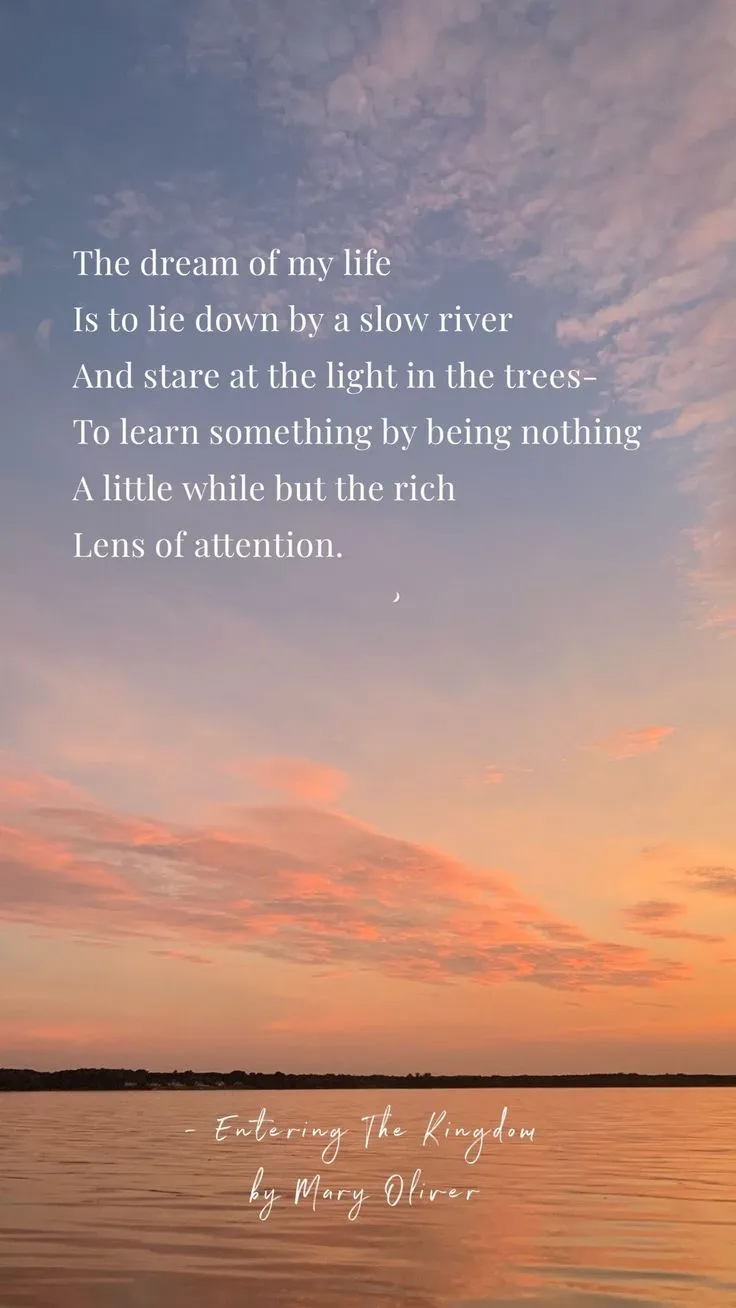 Photo: Mary Oliver, via i.pinimg.com
Comfort re-reads deserve their own mention. A remarkable number of people described returning, again and again, to books they had already read — sometimes many times. The Hobbit. Anne of Green Gables. Winnie-the-Pooh. A Year in Provence. The familiar, it turns out, is profoundly calming. Knowing how a story ends removes the anxiety of narrative tension and allows you to sink into language and character as pure pleasure.
What They Are Deliberately Avoiding
Equally illuminating is what contented readers consistently choose not to read before sleep. Psychological thrillers, news journalism, true crime, anything with graphic violence or unresolved darkness — these are almost universally saved for daytime hours. "I love a good thriller," says Anya, a graphic designer in Edinburgh, "but I learned the hard way that reading one at eleven at night means I'm still mentally solving the plot at two in the morning."
Several people also mentioned stepping away from social media reading — the habit of scrolling through opinion pieces, comment threads and news updates in bed — as one of the most significant changes they had made to their wellbeing. "Swapping my phone for a book at bedtime was honestly more impactful than any wellness app I've ever tried," says Marcus, a freelance writer in Bristol.
Building Your Own Bedside Ritual
The good news is that there is no single formula here — only the consistent principle of choosing, with a little intention, what emotional world you want to inhabit before you sleep.
A few things worth trying: keep one book solely for bedtime reading, separate from whatever you are devouring on your commute or at the weekend. Choose it for its feeling rather than its prestige or topicality — the book that makes you feel safe, curious, quietly delighted. Give yourself permission to abandon anything that leaves you agitated or unsettled, however critically acclaimed it might be.
And if you have not yet tried reading poetry before sleep, consider this a gentle nudge. Five minutes. One poem. See what it leaves behind.
A Few Titles to Start With
For those looking to refresh their bedside stack, here are some titles that came up most warmly in our conversations:
- The Salt Path by Raynor Winn — walking, loss and extraordinary resilience
- The Thursday Murder Club by Richard Osman — warm, funny, genuinely comforting
- Devotions by Mary Oliver — poetry that makes you grateful to be alive
- The Unlikely Pilgrimage of Harold Fry by Rachel Joyce — tender and quietly profound
- Notes from a Small Island by Bill Bryson — affectionate, funny, deeply British
- Enchantment by Katherine May — nature, rest and the art of wintering well
- Miss Read's Thrush Green series — village life at its most gentle and restorative
Your bedside table, it turns out, is one of the most honest reflections of how you are choosing to meet your life. Fill it accordingly.