Five Messy Minutes: The Early Morning Writing Habit That's Quietly Fixing British Mental Health

It's 6.47am in Leeds. The kettle hasn't finished boiling. Priya Sharma, 34, is already at her kitchen table, notebook open, pen moving. She isn't writing anything meaningful — not exactly. There are half-finished sentences, a complaint about her neighbour's recycling bins, something about a dream she can barely remember. None of it makes sense. All of it, she says, has changed her life.
Priya is one of a quietly growing number of Britons who have adopted what's loosely called "morning pages" — the practice of writing freely, without editing or intention, the moment you wake up. No audience, no structure, no rules. Just whatever spills out of your brain onto the page before the day gets its hands on you.
"I thought it would feel pointless," she admits. "Writing rubbish on purpose? But within two weeks I noticed I was less anxious at work. My head felt clearer. I can't fully explain it, but something shifted."
What Exactly Are Morning Pages?
The concept was popularised by American author Julia Cameron in her 1992 book The Artist's Way, but it's taken on a distinctly British life of its own in recent years. The idea is straightforward: each morning, before you check your phone or speak to another human being, you write three longhand pages — or whatever you can manage — of completely unfiltered thought. No topic, no theme, no pressure to be interesting or coherent.
It's the opposite of a diary. It's not a gratitude list or an affirmation exercise. It's closer to a mental drain — a way of emptying the overnight accumulation of worry, noise, and unprocessed feeling before the world demands your full attention.
And it's catching on. Searches for morning journalling practices have surged across the UK, with wellness communities on Reddit, Instagram, and even local Facebook groups buzzing with people sharing their notebooks and their small victories.
What's Actually Happening in Your Brain
Dr. Catherine Holt, a cognitive neuroscientist based in Bristol, isn't surprised by the growing enthusiasm. "When we write by hand, particularly in a free, unstructured way, we engage the brain's default mode network — the part responsible for self-reflection, emotional processing, and making connections between ideas," she explains. "In our always-on culture, that network rarely gets a proper workout."
First thing in the morning, the brain is also in a semi-hypnagogic state — the drowsy, half-dreaming phase where the prefrontal cortex, home of our inner critic and social self-monitoring, hasn't fully come online yet. "That's actually a neurologically ideal moment for honest self-expression," says Dr. Holt. "You're less defended. Things surface that might not appear if you tried to journal at lunchtime."
Research published in the journal Advances in Psychiatric Treatment has long supported expressive writing as a tool for reducing anxiety and processing trauma. Morning pages take that principle and strip away any remaining formality.
Real People, Real Results
In Edinburgh, retired teacher Malcolm Grant, 62, started morning pages during the pandemic and hasn't stopped since. "I was struggling with the loss of routine, the isolation. A friend mentioned morning pages almost in passing." He pauses. "I cried during the first session. I didn't even know I had things to cry about. It was like opening a valve."
For Manchester-based graphic designer Chloe Beattie, 28, the benefit was more practical. "I'd been creatively blocked for months. Nothing felt original. Morning pages didn't give me ideas directly, but they cleared away all the mental clutter that was sitting on top of my creativity. Suddenly there was space again."
Not everyone finds it transformative overnight. Tom Fielding, a secondary school teacher in Norwich, tried and abandoned the practice three times before it clicked. "The trick for me was genuinely giving myself permission to write badly. I kept trying to make it good. Once I stopped, it started working."
How to Begin (Without Overthinking It)
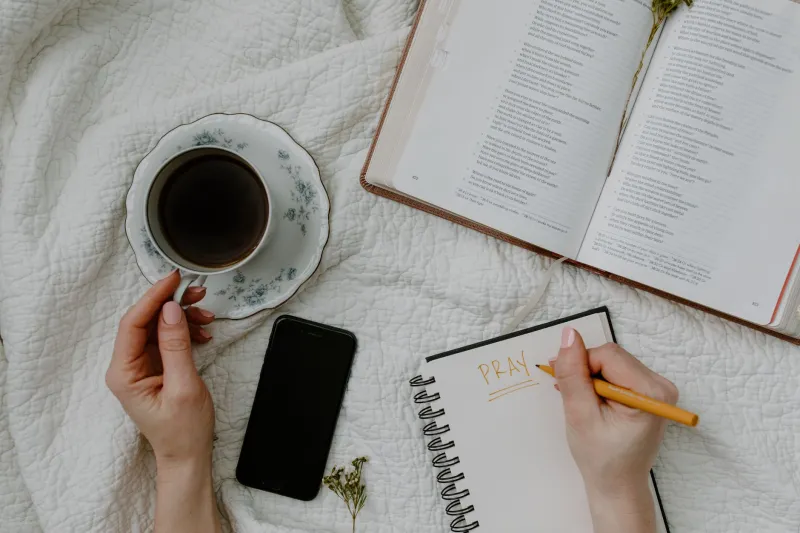
The beauty of morning pages is that they require almost nothing. A notebook. A pen. A few minutes before the rest of your household wakes up.
A few things that practitioners across the UK swear by:
Keep it longhand. Typing on a laptop invites editing. The physical act of handwriting slows you down just enough to stay honest.
Don't read it back. At least not for the first month. The pages aren't meant to be literature. Reading them too soon can trigger self-consciousness.
Lower your bar dramatically. "I wrote 'I don't know what to write' for an entire page once," says Priya. "That's fine. That's the practice."
Do it before your phone. This is the part people resist most and report as most important. Even a two-minute scroll changes the quality of what comes out.
Start small. Three pages sounds like a lot. One page is enough. Five minutes is enough. The ritual matters more than the volume.
A Quiet Kind of Revolution
There's something wonderfully low-tech about this particular wellness trend. No app subscription. No wearable device. No coach. Just you, some paper, and the strange, generous chaos of your own unedited mind.
In a culture that has medicalised mental health support to the point where waiting lists stretch for years, there's something quietly radical about a practice this accessible making this much difference to this many people.
Priya is still writing her messy, unpunctuated, occasionally incomprehensible morning pages every day. The kettle still boils. The neighbour still gets the recycling wrong. But she faces it all a little differently now.
"It's like having a conversation with yourself that you've been putting off for years," she says. "Turns out you're better company than you thought."